

The cybersecurity skills gap in Asia-Pacific is now showing up in real careers. New Kaspersky data shows that nearly half of APAC cybersecurity professionals (48%) made mistakes early in their careers because they lacked key knowledge.
This comes even as the region’s security workforce keeps growing. However, gaps in core technical and analytical skills still hold many teams back.
Where the Cybersecurity Skills Gap Is Widest
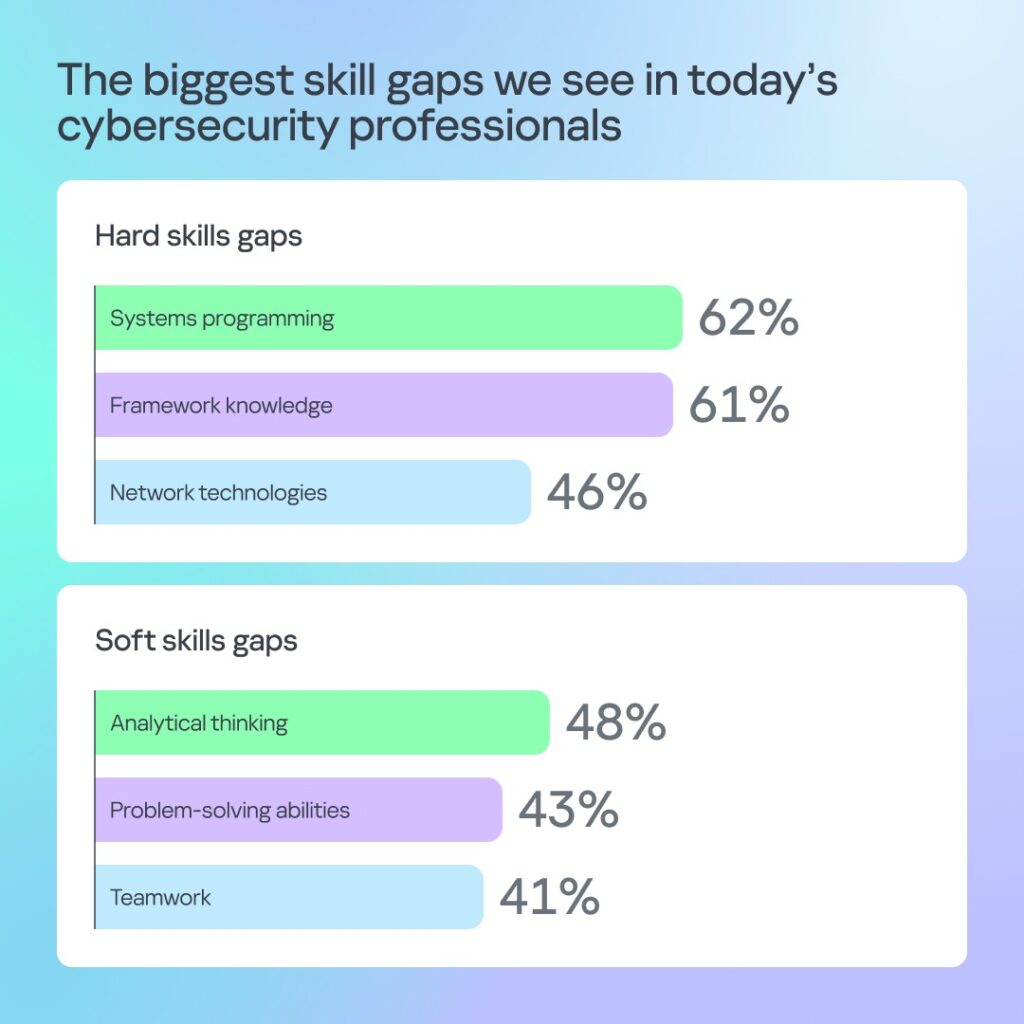
On the technical side, the biggest shortfalls are in systems programming (62%), framework knowledge (61%) and network technologies (46%).
Soft skills also tell a similar story. Analytical thinking tops the list at 48%, followed by problem-solving (43%) and teamwork (41%). In other words, the cybersecurity skills gap is not only about code and tools. It also covers how people think through problems and work with others.
Early-Career Mistakes Point to an Education Gap
Formal education does not always help either. In fact, 25% of APAC respondents said their studies were only slightly useful, or not useful at all, in their daily security work.
As a result, many professionals learn on the job, often the hard way. The most common early-career errors were:
- Neglecting data backups (43%)
- Using outdated security measures (43%)
- Failing to implement identity protection (36%)
These may sound like basic slips. Still, each one can leave an organisation open to serious damage.
Kaspersky Cyber Pathways Offers a Clearer Map
To help close this gap, Kaspersky offers Cyber Pathways. This interactive resource maps out key cybersecurity roles, skills and tools. It suits newcomers, IT generalists, seasoned experts and corporate teams alike.
“What the region needs are professionals who can combine technical depth with strong analytical and problem-solving skills, and that requires structured, practical guidance, not just on-the-job experience,” said Adrian Hia, Managing Director for Asia Pacific at Kaspersky.
“There are growing efforts to address this, and resources like Kaspersky’s Cyber Pathways are a step in the right direction, giving professionals a clearer map of where they stand and where they need to go,” he added.
The platform introduces six ‘Kaspersky Cyber Heroes’. Each hero stands for a vital area of the field: threat intelligence, malware analysis, security operations, security assessment, network security and information security research. Together, they show what each role involves and which skills it needs.
In addition, an interactive career guidance test lets users check their current level. It then points them to the role that best fits their strengths and goals. There are three versions: one for beginners, one for advanced professionals and one for organisations.
Hands-On Training to Close the Cybersecurity Skills Gap
After the test, users get personalised learning recommendations. These draw on Kaspersky’s nearly three decades of experience in fighting cyber threats.
Specifically, the suggestions combine practical programmes from Kaspersky Cybersecurity Training and Kaspersky Academy. Meanwhile, companies can also use online tools from Kaspersky Security Awareness. These tools help teams build safer habits and a stronger security culture.
What It Means for Southeast Asia
For the region, the timing is especially important. A separate global Kaspersky survey found that 81% of APAC organisations have raised their IT security budgets. Vietnam leads at 94%, followed by Indonesia (87%), Malaysia (83%) and India (83%).
Yet bigger budgets alone will not fix the cybersecurity skills gap. Because skills remain the region’s biggest internal risk, practical training needs to grow alongside spending. This matters even more since cyber incidents now affect more than four in five people across 14 professions.
Overall, the findings suggest that strong cyber resilience in APAC depends on people as much as tools. So, as investment rises, accessible and practical training will be just as critical.