
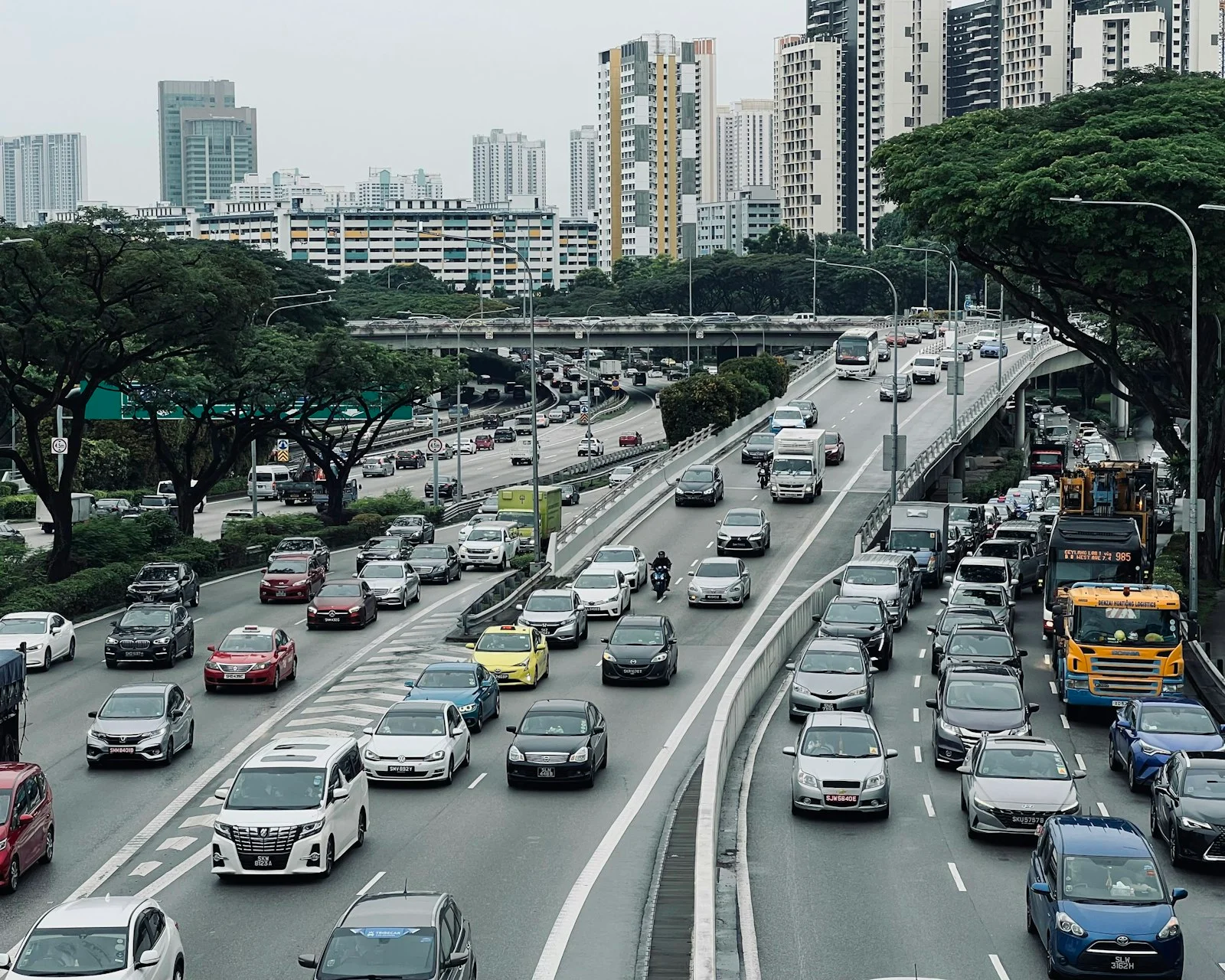

The Singapore car plate meaning is packed into three parts: a prefix that shows the vehicle class, a number of up to four digits, and a final checksum letter that guards against copying errors. Most private cars start with S, plate colours reveal special schemes such as red off-peak cars, and the last letter comes from a fixed calculation.
This guide continues the RiseAsia car plates series, after our explainers on Indonesian car plates, Thai car plates, Philippine plate numbers and Vietnam licence plates.
How a Singapore car plate is structured
The Land Transport Authority (LTA) describes a vehicle registration number (VRN) as a prefix based on vehicle type, followed by up to four digits and a one-letter suffix. Its own example on the OneMotoring standard registration page is PA1234Y, where PA marks a bus.
Read it in three steps:
- Prefix (one to three letters): tells you the vehicle class, such as S for cars or G for light goods vehicles.
- Number (1 to 9999): the running number within that series.
- Suffix (one letter): a checksum worked out from the prefix and number, so a mistyped plate is easier to spot.
Singapore car plate prefixes and what they mean
The first letter is the quickest clue. LTA splits goods vehicles by weight: G for light goods vehicles up to 3,500kg, Y for heavy goods vehicles up to 16,000kg and X for very heavy goods vehicles above that.
| Prefix | Meaning |
|---|---|
| S (e.g. SBA) | Private cars, the main series since 1984 |
| E | Older private car series used in the 1970s and early 1980s, after the first S series ran out |
| SH | Taxis |
| SBS / SMB / SG | Public buses: SBS and SMB were the SBS Transit and SMRT prefixes, while newer government-owned buses use SG |
| P (e.g. PA, PD) | Buses, including private and excursion buses |
| G | Light goods vehicles (up to 3,500kg) |
| Y | Heavy goods vehicles (3,500kg to 16,000kg) |
| X | Very heavy goods vehicles (above 16,000kg) |
| W | Engineering plant |
| F | Motorcycles (e.g. the FB series, such as FBZ) |
| TR | Trailers |
| Q / QX / QY | Q: company cars registered before April 1998, now rare; QX: emergency and enforcement agencies; QY: government and statutory board cars registered before April 2019 |
| RU / PU / RD | Restricted-use vehicles in approved areas, Pulau Ubin vehicles, and research and development vehicles |
| S … CD / CC / TE | Diplomatic corps, consular corps and technical staff of foreign missions (letters appear at the end) |
Is it true that a Singapore car plate starts with S only? For normal private cars, yes. New private cars get an S series, though older E-series cars and special plates still appear.
Singapore plate number colours and what they mean
Colour is the second clue. LTA says standard plates use white characters on a black background, while reflective plates use black characters on white at the front and on yellow at the rear.
| Plate colour | What it means |
|---|---|
| White on black | Standard plate for cars and motorcycles |
| Black on white (front) and black on yellow (rear) | Standard reflective plate option |
| White on red | Off-peak car (often called a “red plate”) |
| Red-orange top half, yellow bottom half | Classic or vintage car under a restricted scheme |
| Half yellow, half blue | Research and development vehicle |
| Green and red, split diagonally | Restricted-use (RU) vehicle |
| Orange | Vehicle licensed to carry hazardous materials |
Red plate car Singapore meaning
A red plate marks an off-peak car. According to LTA’s off-peak car page, a Revised Off-Peak Car (ROPC) has a red plate with white lettering and may not be driven from 7am to 7pm on weekdays unless the owner buys a S$20 e-Day Licence (as of November 2026). In return, a new ROPC gets a rebate of up to S$17,000 against its COE and ARF, plus road tax savings of up to S$500 a year.
Red and yellow plate car meaning
A plate split into a reddish top and a yellow bottom belongs to a classic or vintage car. Cars on the classic and vintage schemes may be driven only on a limited number of days a year, and the plate must carry an LTA seal.
How to calculate the last alphabet of a Singapore car plate
The suffix is a checksum. LTA does not publish the formula, but independent sources describe the same method, and it reproduces their examples.
- Take the last two letters of the prefix and turn them into numbers (A = 1, B = 2 … Z = 26). For a one-letter prefix, use 0 and then that letter.
- Write the number as four digits, adding leading zeros (for example, 23 becomes 0023).
- You now have six numbers. Multiply them by 9, 4, 5, 4, 3 and 2 in order, then add the results.
- Divide the total by 19 and keep the remainder.
- Match the remainder to a letter: 0 = A, 1 = Z, 2 = Y, 3 = X, 4 = U, 5 = T, 6 = S, 7 = R, 8 = P, 9 = M, 10 = L, 11 = K, 12 = J, 13 = H, 14 = G, 15 = E, 16 = D, 17 = C, 18 = B.
Worked example (SBA 1234): the last two prefix letters are B and A, which give 2 and 1. The digits are 1, 2, 3 and 4. The sum is (2×9) + (1×4) + (1×5) + (2×4) + (3×3) + (4×2) = 18 + 4 + 5 + 8 + 9 + 8 = 52. Dividing 52 by 19 leaves a remainder of 14, which matches G. The full plate would read SBA 1234 G.
Because there are only 19 possible remainders, seven letters never appear as a checksum: F, I, N, O, Q, V and W. Seeing one at the end usually means a misread.
Bidding for a Singapore car plate number
Singapore does not offer free-text vanity plates, but owners can bid for a preferred number in an available series. The OneMotoring VRN page sets out the process (as of November 2026):
- Search available numbers by vehicle type and prefix on OneMotoring.
- Submit a bid with up to three choices of the same prefix type. The minimum bid is S$1,000 (incl. GST), with a S$18.53 service fee per submission.
- Bid during the main exercise, which runs from Friday to the following Wednesday at 4.30pm.
- Check the result, released at noon on the Wednesday after the main exercise. Bids cannot be withdrawn.
- Use the number within one year, on a new car through your dealer or on your existing car for a replacement fee.
Owners can also keep a number when changing cars. Popular numbers fetch high prices: the plate S32H was reported to have sold for S$335,000 in 2016.
Rules on displaying Singapore number plates
Every vehicle must show its registration number on plates at the front and the rear, and the plates must follow LTA’s official design rules. Where plates must be sealed, as on off-peak and classic cars, owners who miss the stipulated deadline face a fine of up to S$2,000 or up to six months’ jail, according to the OneMotoring VRN page (as of November 2026).
FAQ
What are the different types of car plates in Singapore?
The main types are standard plates (white on black, or black on white and yellow), red off-peak plates, red-and-yellow classic and vintage plates, and special-scheme plates such as RU, PU and research vehicles.
How to calculate the last alphabet of a Singapore car plate?
Convert the last two prefix letters to numbers, add the four digits, multiply the six values by 9, 4, 5, 4, 3 and 2, and divide the total by 19. The remainder maps to one of 19 letters, from A for 0 to B for 18.
What does the plate number colour mean in Singapore?
Colour shows the vehicle’s scheme. Black or white-and-yellow plates are standard, red means an off-peak car, red and yellow marks a classic or vintage car, and orange marks hazardous goods.
How can I check if a Singapore car plate number is available?
Use the number search on OneMotoring’s VRN bidding page, which lists available numbers by vehicle type and prefix.
What comes next for Singapore number plates
Singapore’s plates may soon gain one more colour clue. LTA and the Singapore Civil Defence Force ran an online poll for electric vehicle plate designs from 25 September to 9 October 2026, comparing green and blue options that help first responders spot EVs. Visiting for the Singapore International Marathon? Try reading the plates around you: prefix, colour and final letter tell a quick story about each vehicle.