
Why do Koreans use metal chopsticks? In short, metal utensils were a mark of status in Korea for more than 1,500 years, and cheap, mass-produced stainless steel made them everyday tableware for everyone after the Korean War. Durability, easy cleaning and a meal built around hot soup and many side dishes helped the habit stick.
Some popular explanations, such as silver chopsticks that “detect poison”, are only partly true. This guide separates the well-supported history from the folklore. It is part of RiseAsia’s Asia explainers series.
Metal chopsticks in early Korea
Chopsticks came to Korea from China, but Koreans took to metal versions early. The oldest metal chopsticks reported in Korea come from the tomb of King Muryeong, who ruled the Baekje kingdom from 501 to 523. According to a Korea JoongAng Daily feature, the tomb held two bronze pairs, about 21 cm and 20 cm long. They were already flat and had rings at the top for a connecting chain.
Archaeologists list spoons and chopsticks among the metal objects found in the tomb’s entrance passage. They may have been placed there for funeral rites. The finds are displayed at the Gongju National Museum.
For centuries, metal chopsticks belonged mostly to royalty and the upper classes. Ordinary people in the early and mid-Joseon period (1392–1910) often ate rice and soup with a spoon. Chopsticks spread more widely in the late Joseon period, as side dishes such as kimchi became a bigger part of the everyday meal.
Silver and the poison test: fact or myth?
A popular explanation is that Korean kings used silver chopsticks to check their food for poison. The royal court did use silver utensils, and the belief behind them has a real chemical basis. But it only works for some poisons.
Silver reacts with sulphur compounds and forms a black layer of silver sulphide. This is the same tarnish that appears when a silver spoon touches egg yolk. A widely cited explanation is that arsenic poisons in the past were often impure and contained sulphur compounds, so a silver utensil could sometimes darken. However, as doctors writing for the Singapore Medical Association explain, pure arsenic trioxide contains no sulphur and does not react with silver. So silver chopsticks could miss the most dangerous form of arsenic entirely.
In other words, silver did not detect arsenic itself. It detected sulphur. That made it a weak, unreliable safety check, even if it worked now and then.
Brass tableware, then stainless steel
During the Goryeo and Joseon periods, many households used brass tableware known as yugi (놋그릇), including bowls, spoons and chopsticks. Brass held heat well, which suited winter soups. Higher-quality forged bronze, called bangjja yugi, was especially prized.
Brass needs regular polishing, though. According to the Korean Food Promotion Institute, bangjja yugi “almost disappeared” as coal briquettes came into use in the late 20th century. A popular explanation is that briquette fumes tarnished brass quickly, making it tiresome to keep. That link is widely repeated but rarely documented.
Stainless steel filled the gap. After the Korean War, Korea began producing stainless steel at home, and flat stainless chopsticks appeared in the 1960s. Steel was cheaper, lighter than brass, rust-resistant and easy to wash in hot water. A National Museum of Korea exhibition on Korean dining notes that stainless steel gradually replaced brass in many homes in the 20th century because it was affordable, durable and easy to maintain.
Claims of a direct 1970s government campaign promoting stainless steel are hard to verify. What has been reported, including by Korea JoongAng Daily, is that disposable wooden chopsticks were banned in restaurants in that era on environmental grounds, which may have favoured reusable metal.
Why are Korean chopsticks flat?
The best-supported answer is manufacturing. Flat chopsticks can be stamped or cut from sheet metal, the most efficient way to mass-produce them. The chief executive of a Korean cutlery maker told Korea JoongAng Daily this was why the flat form became standard.
Other popular explanations include:
- A flat stick will not roll off the table.
- A flat metal stick is lighter than a solid round one of the same width.
- The flat surface gives a firmer grip on slippery banchan and grilled meat.
These benefits are real in daily use, but they are explanations people give, not documented reasons for the design.
Sujeo: spoon and chopsticks as a set
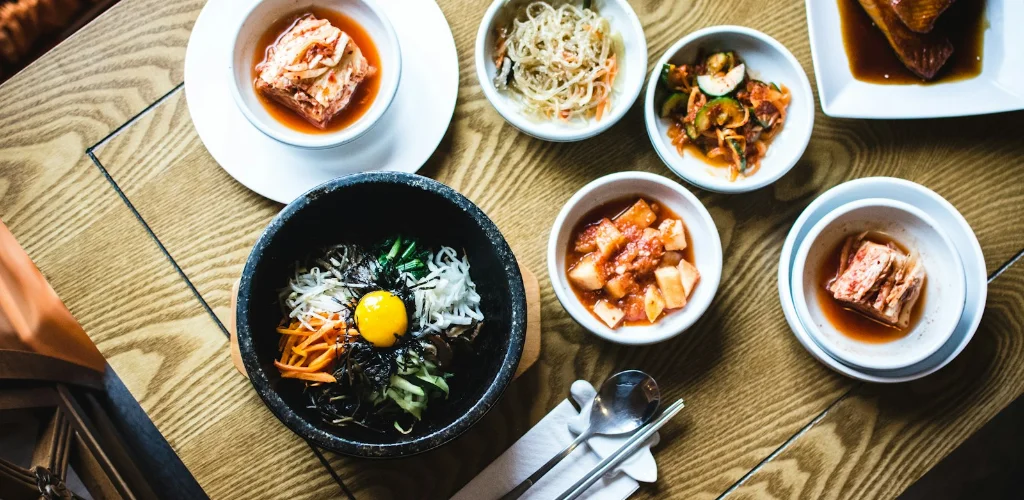
In Korea, the spoon and chopsticks form one set called sujeo (수저). The word combines sutgarak (spoon) and jeotgarak (chopsticks). Unlike in China and Japan, where rice is mostly eaten with chopsticks, Koreans traditionally eat rice and soup with the spoon. Chopsticks are for side dishes.
Matching spoon and chopstick sets are also a common gift. If you visit Korea, you will see matching metal sujeo at almost every table, from street stalls to the canteens where students cram before the Suneung exam.
Korean vs Chinese vs Japanese chopsticks
| Feature | Korea | China | Japan |
|---|---|---|---|
| Usual material | Stainless steel (metal) | Wood, bamboo or plastic | Wood or bamboo, often lacquered |
| Length | Medium | Longest | Shortest |
| Shape | Flat | Thick, often square or round | Round, slender |
| Tip | Blunt to slightly tapered | Blunt | Sharply tapered |
| Suits | Many small banchan, grilling | Large shared dishes | Individual servings, deboning fish |
| Eaten with a spoon? | Yes, for rice and soup | Spoon for soup | Rarely; soup is sipped from the bowl |
These are general patterns. Restaurants in all three countries use disposable wooden chopsticks, and styles vary by region and home.
Chopstick etiquette in Korea
- Wait for the oldest person at the table to start eating before you begin.
- Do not stick chopsticks upright in your rice. It recalls ancestral rites and is seen as bad luck.
- Do not hold your spoon and chopsticks in the same hand at once. Put one down before picking up the other.
- Use the spoon for rice and soup, and the chopsticks for side dishes.
Why do Koreans use metal chopsticks today?
So why do Koreans use metal chopsticks now? Today the reasons are mostly practical. Stainless steel lasts for years, survives hot dishwashers and does not stain from kimchi or soy sauce. It also does not char at a barbecue grill. For Koreans, it is simply habit; for visitors, the slippery flat sticks take a few meals to master.
Like the missing 4th floor in many Asian buildings or the reason Japan is called the Land of the Rising Sun, metal chopsticks show how history and daily life blend in Asian customs. Planning a trip to Seoul? Load up a T-money card, head to a local restaurant and practise your grip.
FAQ
Is there a difference between Chinese and Korean chopsticks?
Yes. Korean chopsticks are usually flat, medium-length and made of stainless steel. Chinese chopsticks are longer and thicker, with blunt ends, and are usually wood, bamboo or plastic.
Are metal chopsticks better than wooden?
Metal chopsticks are more durable, easier to sterilise in hot water and do not absorb odours or stains. Wooden chopsticks are lighter and less slippery, so many beginners find them easier.
Why are Korean chopsticks flat?
Mainly because flat chopsticks are the easiest to mass-produce from sheet metal. Popular explanations add that flat sticks do not roll and grip food firmly.
What is sujeo?
Sujeo (수저) is the Korean term for a matching spoon and chopsticks set. Koreans use the spoon for rice and soup, and the chopsticks for side dishes.