Kaspersky has launched the Cyber Risk Heatmap, a free online tool that shows businesses where their biggest cyber risks lie. The short questionnaire takes about 10 minutes to complete. Then, companies get a clear view of their risk across six key security zones, along with practical next steps.
The launch comes as the threat landscape keeps changing. Today, risk can appear anywhere in a company’s digital setup, from employees and devices to cloud workloads and incident response. As a result, many teams struggle to know where to focus first.
How the Cyber Risk Heatmap Works
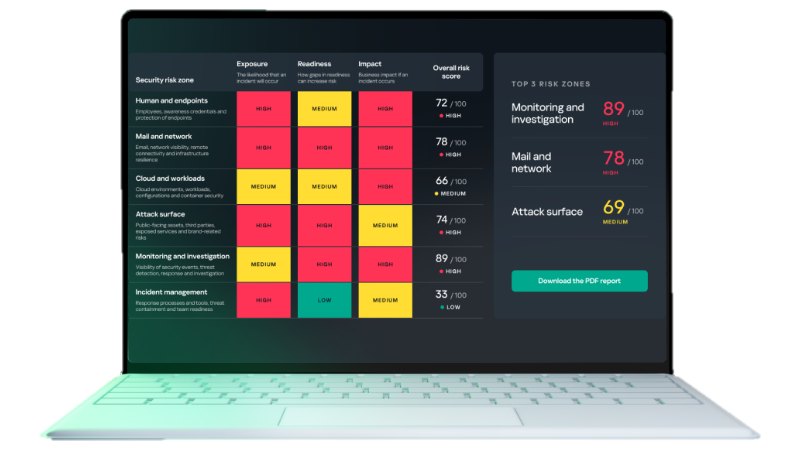
Kaspersky built the Cyber Risk Heatmap as a simple, question-based check. Users answer a set of questions about their current security setup. The tool then rates potential risk across six areas:
- Human and endpoints: employees, awareness, credentials and device protection
- Mail and network: email, network visibility, remote access and infrastructure resilience
- Cloud and workloads: cloud environments, workloads, configurations and container security
- Attack surface: public-facing assets, third parties, exposed services and brand risks
- Monitoring and investigation: visibility of security events, threat detection and response
- Incident management: response processes, tools, threat containment and team readiness
Each zone also gets a rating for exposure, readiness and impact. Exposure is the likelihood that an incident will occur. Meanwhile, readiness shows how gaps in preparation can raise risk, while impact reflects the business damage if an attack succeeds. Together, these feed into an overall risk score out of 100.
Based on the answers, the tool creates a personalised heatmap with colour-coded risk levels. It also highlights the top three zones that need attention first. Users can then download a free PDF report with their results, key findings and practical recommendations.
A Starting Point, Not a Full Audit
Kaspersky positions the tool as a high-level check rather than a technical audit. In other words, it does not replace penetration testing, vulnerability assessments, compromise assessments or detailed security audits. Instead, it helps companies spot likely priorities before they commit time and budget to deeper work.
“Stronger cybersecurity starts with knowing where to focus. Our Cyber Risk Heatmap helps organisations identify potential risks and set clear priorities, with personalised reports and practical recommendations tailored to their needs,” says Yana Shevchenko, Head of Corporate Product Marketing at Kaspersky.
Why the Cyber Risk Heatmap Matters for Businesses in Asia
For companies across Southeast Asia, a quick self-check like this is especially useful. Recent cases show how wide the risk can be. For example, Kaspersky recently flagged a barcode scanner vulnerability that could open warehouse networks to attackers. At the same time, the region still faces a cybersecurity skills gap, with 48% of APAC security professionals admitting to early-career mistakes.
So, knowing where to look first matters. The Cyber Risk Heatmap gives teams a fast, structured way to rank their risks. From there, they can decide whether they need deeper testing, new tools or more staff training.
Kaspersky, founded in 1997, says nearly 200,000 organisations worldwide trust its protection. Businesses that want to see where they stand can take the free assessment on Kaspersky’s website.