



A barcode scanner vulnerability could give hackers a quiet way into warehouse networks. Kaspersky researchers found that attackers can abuse a widely used scanner model from a major manufacturer. In doing so, they can send malicious commands to connected computers.
The finding matters because modern warehouses are no longer simple storage spaces. Instead, they run on a complex mix of connected devices and systems. At the same time, global e-commerce sales have nearly doubled since 2019 to more than US$6 trillion. As a result, any disruption or delay in the delivery chain can cause heavy financial and reputational losses.
How the Barcode Scanner Vulnerability Works
Kaspersky Security Services researchers studied several ways to attack warehouse infrastructure, including through everyday devices. Notably, scanners like the one they tested are common in warehousing, retail and many other sectors.
In a typical setup, handheld scanners talk to a base station. The base station, in turn, links to a workstation or another business system. However, the scanners and the base station do not authenticate each other. That missing check sits at the core of the barcode scanner vulnerability.
According to Kaspersky, an attacker within wireless range could inject keystrokes into the connected device. In some cases, this could even lead to remote code execution without any user interaction.
A Four-Step Attack Over Bluetooth
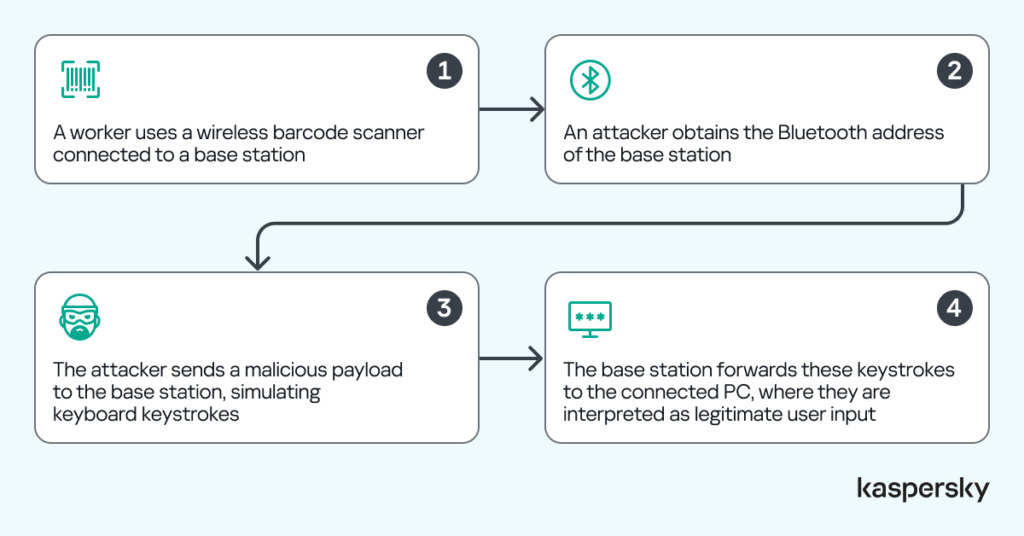
In Kaspersky’s hypothetical scenario, a worker uses a wireless scanner as usual. Meanwhile, an attacker obtains the base station’s Bluetooth address, for example by passively eavesdropping on Bluetooth traffic.
Next, the attacker sends a malicious payload to the base station that mimics keyboard keystrokes. The base station then forwards these keystrokes to the connected PC. Because the PC treats them as legitimate user input, the attacker may be able to run unauthorised commands. The researchers also observed this attack pattern across devices from multiple vendors.
Why One Scanner Can Put a Whole Warehouse at Risk
However, the barcode scanner vulnerability is only the entry point. Once the attack succeeds, the attacker gains an initial foothold on a computer inside the warehouse network. That foothold is valuable because the computer holds a trusted position in daily operations and connects to critical systems.
Moreover, the threat reaches beyond warehouses to retail and any other sector that relies on these devices. Kaspersky also believes attackers could use similar methods on other warehouse devices, such as portable data terminals (PDTs) and thermal printers. From there, they could reach Warehouse Management Systems (WMS).
“Modern retail and logistics are profoundly digital, from enterprise-wide management platforms down to every device in a worker’s hands. This pervasive connectivity means that any technology at any tier can become an entry point for a cyberattack capable of destabilizing the entire ecosystem — as our research shows, even a single barcode scanner,” said Sergey Sidorov, Head of Industrial Security Services at Kaspersky.
“The warehouse sector, and the broader retail industry, should treat cybersecurity as a top priority across every layer of their operations,” he added.
How to Reduce Barcode Scanner Vulnerability Risks
To strengthen security in warehouse environments, Kaspersky experts recommend that companies:
- Verify every new device before it connects to the network.
- Disable unused Bluetooth interfaces and enforce strong authentication.
- Segment warehouse networks so they permit only essential connections.
- Apply security updates promptly to both devices and the WMS.
- Limit account permissions to the minimum required.
- Run regular full-scale attack-path exercises, including scenarios with insiders who hold legitimate credentials.
For deeper checks, Kaspersky ICS Security Assessment reviews industrial, OT and networked devices on-site to uncover hidden risks without disrupting operations. In addition, Kaspersky Industrial Cyber Security (KICS) helps logistics firms and other industrial organisations gain better visibility across their infrastructure.
Overall, the barcode scanner vulnerability is a reminder that small devices can carry big risks. It also adds to recent Kaspersky findings that cyber incidents now affect more than four in five people across 14 professions. Readers can find the full security audit of the warehouse digital ecosystem in Kaspersky’s Securelist report.