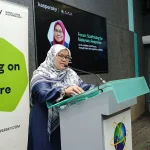


AMD has completed its purchase of World Labs, the San Francisco AI start-up founded by Stanford professor Dr Fei-Fei Li. The AMD World Labs acquisition, announced in September, carried an all-stock value of about US$8.2 billion. It gives the chipmaker its own frontier research team working on AI that understands 3D space.
AMD confirmed the close on 16 November. Li now joins as executive vice president and chief scientist, reporting directly to chair and CEO Dr Lisa Su. However, the completion notice did not disclose any further financial terms.
What World Labs Builds
World Labs develops so-called world models. These are AI systems that generate, reconstruct and simulate interactive 3D environments from text, images or video. In addition, the company works on technology for robot learning and simulation.
Li co-founded the lab in 2024 with Justin Johnson, Ben Mildenhall and Christoph Lassner. Earlier this year, Li and Su showed its Marble model turning a handful of photos into a full 3D scene. Johnson and Mildenhall will continue to lead the team alongside Li inside AMD.
Unlike large language models, world models have to reason about geometry, physics and time. As a result, they are demanding to train and run. That is exactly the kind of workload a chipmaker wants to understand early.
Why the AMD World Labs Acquisition Matters

For AMD, the logic is about designing hardware around where models are heading. Su said the company must “optimize compute platforms and models together” to build infrastructure for the next era of AI. In practice, World Labs researchers will work with AMD engineers so that their findings shape future chips, software and systems.
The two companies were already close before the deal. AMD Ventures backed World Labs in its Series B. It returned for the US$1 billion round in February, alongside Autodesk, Fidelity, Nvidia and Singapore’s Sea. The pair had also run an inference optimisation and training partnership since 2025.
This is AMD’s second AI purchase in a few months, following its August deal for chip start-up Taalas. CNBC reports it is also AMD’s second-largest acquisition, behind the roughly US$50 billion Xilinx deal of 2022.
Meanwhile, the race to pair models with silicon is not limited to the US. Across Asia, chip firms are also betting on dedicated AI hardware, such as DEEPX’s US$100 million Samsung 2nm plan.
What the AMD World Labs Acquisition Means for Southeast Asia
The AMD World Labs acquisition is a US deal, but it has clear regional threads. For example, Singapore-based Sea, the group behind Shopee and Garena, was among World Labs’ backers in its latest funding round.
Malaysia also sits close to AMD’s engineering base. The company has operated in Penang since 1972. In August 2025, it opened a 209,000-square-foot office and engineering lab in Bayan Lepas. The site focuses on chip design and AI computing. Around then, AMD also launched its Developer Cloud in Malaysia with 100,000 free GPU hours for local researchers.
Physical AI also has practical uses in the region’s manufacturing, logistics and property sectors. Examples include training warehouse robots in simulation and building digital twins of factories or new townships. As World Labs’ research filters into AMD products, regional developers could gain better tools for this work.
What to Watch Next
The key question is how quickly the AMD World Labs acquisition shows up in AMD’s roadmap. That includes its Instinct data centre accelerators and its open ROCm software. For now, AMD says the team will keep advancing foundational model research. It will also work with AMD engineers on future infrastructure for customers and developers.
Read the full details in AMD’s completion announcement.