
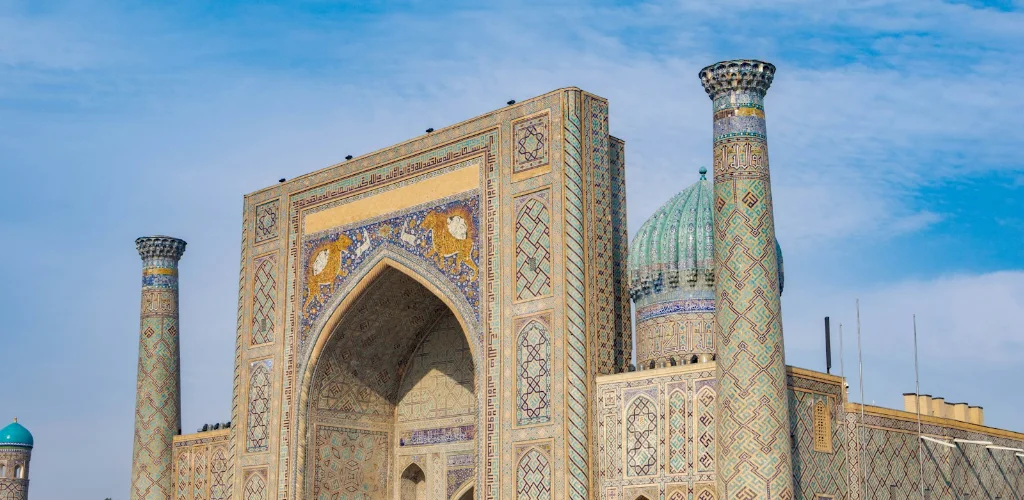

Samarkand, in central Uzbekistan, is one of the great cities of the old Silk Road. This Samarkand travel guide covers its main sights, how to get there, entry rules and when to go. For travellers from Asia, many of whom can now enter Uzbekistan without a visa, it is an easy and rewarding trip.
Why Samarkand Is a UNESCO World Heritage City
UNESCO inscribed “Samarkand – Crossroad of Cultures” on the World Heritage List in 2001. The listing traces the city back to ancient Afrosiab, founded in the 7th century BC. Samarkand saw its greatest growth in the Timurid period of the 14th and 15th centuries. That era left the domes, tiled portals and grand squares that draw visitors today.
The protected property has five parts. They include the Afrosiab archaeological area, the medieval Timurid city and later European quarter, and the site of Ulugh Beg’s observatory.
Samarkand Travel Guide: Seven Sights Not to Miss
1. Registan
The Registan is the city’s showpiece square. It is framed on three sides by grand madrasas with tiled facades. Visit at sunset or after dark, when the buildings are lit up.
2. Gur-e-Amir
This ensemble is the resting place of Amir Timur, founder of the Timurid dynasty. Its ribbed blue dome and gilded interior are among the finest examples of the period’s craftsmanship.
3. Shah-i-Zinda
Shah-i-Zinda is a narrow avenue of mausoleums built over several centuries. Each facade shows a different style of glazed tilework. It is a quiet place, so dress modestly and keep voices low.
4. Bibi-Khanym
Built in the Timurid era, Bibi-Khanym was one of the largest structures of its time in Central Asia. Its huge entrance arch shows the scale of the city’s ambitions six centuries ago.
5. Ulugh Beg Observatory
Ulugh Beg, Timur’s grandson, was a ruler and a respected astronomer. The remains of his observatory and a small museum tell the story of the science carried out here.
6. Siab Bazaar
Next to Bibi-Khanym, this busy market sells round Samarkand bread, dried fruit, nuts and spices. It is a good place to try local snacks and watch daily life.
7. Afrosiyob
The grassy hills of Afrosiyob mark the oldest part of the city. A museum on the site displays finds from early Samarkand, including fragments of painted murals.
Getting to Samarkand
Most visitors arrive via Tashkent, the capital. The Afrosiyob high-speed train links Tashkent and Samarkand in about two hours, against roughly five hours by road, Euronews reports. Tickets can be booked on the Uzbekistan Railways site, eticket.railway.uz, or at station counters. Bring your passport to board. Only a few fast trains run each day, so book early in spring.

Samarkand also has its own international airport. It handled more than 1.5 million passengers in 2025, served by 24 airlines across 30 destinations, according to Samarkand International Airport.
Entry Rules for Asian Visitors to Samarkand
As of November 2026, Uzbekistan’s Ministry of Foreign Affairs lists these visa-free stays:
- Malaysia, Singapore, Indonesia, Brunei, Japan, South Korea and China: up to 30 days.
- Hong Kong and Macao SAR: up to 10 days.
- India: up to 30 days from 1 September 2026, for holders of certain valid third-country visas with an onward ticket.
Travellers from Thailand, the Philippines and Vietnam can apply for an e-visa through the official e-visa.gov.uz portal. A single-entry e-visa costs USD20. Rules can change, so check the ministry’s page before you travel.
Also read: CBT Kyrgyzstan: How Village Homestays Keep Tourism Income Local
Best Time to Visit and Money Tips
Spring and autumn are the most comfortable seasons, roughly March to mid-June and September to October. July and August are very hot and dry, while winters are cold. Sightsee early or late in the day during summer.
The local currency is the Uzbek som (UZS). Larger hotels and restaurants usually take Visa and Mastercard. Carry cash for bazaars, taxis and small cafes. ATMs and exchange counters are common in Samarkand.
With fast trains, easier entry and a growing list of flights, Samarkand is now closer than ever for travellers across Asia. Use this Samarkand travel guide as a starting point, and check entry rules again before you book.