
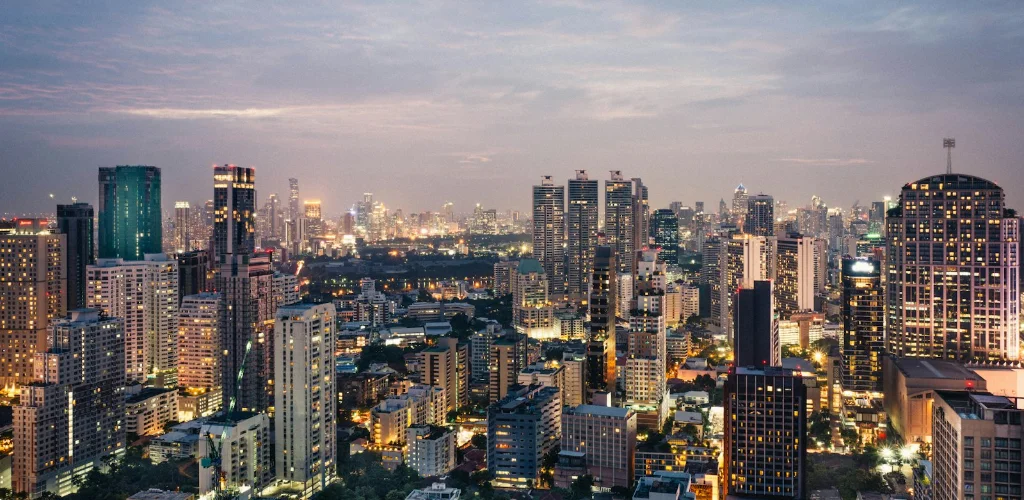

The Thailand minimum wage ranges from THB 337 to THB 400 a day, depending on the province (as of November 2026). These rates have applied since 1 July 2025, and the Wage Committee has not approved any newer increase.
This guide is part of RiseAsia’s minimum wage series, which started with our look at the Vietnam minimum wage. Below you will find the full rate table, how monthly and hourly pay work, who is covered and what is coming next.
How the Thailand minimum wage is set
Thailand does not have one national figure. A tripartite Wage Committee, with members from government, employers and workers, sets daily rates by province after reviewing proposals from provincial subcommittees. The rates become law once published in the Royal Gazette.
The rates in force today come from Wage Committee Notification No. 14, signed on 17 June 2025 and published in the Royal Gazette on 1 July 2025, the day it took effect. It replaced Notification No. 13, which had set 17 tiers from 1 January 2025. The main change in July 2025 was that Bangkok rose from THB 372 to THB 400, and that certain hotels and entertainment venues moved to THB 400 nationwide.
Thailand minimum wage by province
The table below lists every tier under Notification No. 14. Together, the tiers cover all 77 provinces (rates as of November 2026).
| Daily rate (THB) | Provinces or areas |
|---|---|
| 400 | Bangkok, Chachoengsao, Chonburi, Phuket, Rayong, Koh Samui district (Surat Thani) |
| 380 | Mueang Chiang Mai district, Hat Yai district (Songkhla) |
| 372 | Nakhon Pathom, Nonthaburi, Pathum Thani, Samut Prakan, Samut Sakhon |
| 359 | Nakhon Ratchasima |
| 358 | Samut Songkhram |
| 357 | Khon Kaen, Chiang Mai (other districts), Prachin Buri, Phra Nakhon Si Ayutthaya, Saraburi |
| 356 | Lop Buri |
| 355 | Nakhon Nayok, Suphan Buri, Nong Khai |
| 354 | Krabi, Trat |
| 352 | Kanchanaburi, Chanthaburi, Chiang Rai, Tak, Nakhon Phanom, Buriram, Prachuap Khiri Khan, Phang Nga, Phitsanulok, Mukdahan, Sakon Nakhon, Songkhla (other districts), Sa Kaeo, Surat Thani (other districts), Ubon Ratchathani |
| 351 | Chumphon, Phetchaburi, Surin |
| 350 | Nakhon Sawan, Yasothon, Lamphun |
| 349 | Kalasin, Nakhon Si Thammarat, Bueng Kan, Phetchabun, Roi Et |
| 348 | Chai Nat, Chaiyaphum, Phatthalung, Sing Buri, Ang Thong |
| 347 | Kamphaeng Phet, Phichit, Maha Sarakham, Mae Hong Son, Ranong, Ratchaburi, Lampang, Loei, Sisaket, Satun, Sukhothai, Nong Bua Lamphu, Amnat Charoen, Udon Thani, Uttaradit, Uthai Thani |
| 345 | Trang, Nan, Phayao, Phrae |
| 337 | Narathiwat, Pattani, Yala |
The THB 400 rate for hotels and entertainment venues
Two business types pay at least THB 400 a day in every province, even where the local rate is lower:
- Hotels in categories 2, 3 and 4 under the hotel regulations. Category 1 hotels, which offer rooms only and have no more than 50 rooms, are not included.
- Entertainment and service venues covered by the Service Establishment Act, such as pubs, bars, nightclubs and karaoke venues.
So a hotel worker in Nan, where the general rate is THB 345, must earn at least THB 400 a day if the hotel is in categories 2 to 4.
Monthly and hourly pay under the minimum wage
The notification sets rates per day only. It defines a “day” as normal working hours, up to 8 hours, or 7 hours for work that may harm health or safety. The Labour Protection Act also caps normal hours at 8 a day and 48 a week.
The rate applies to daily and monthly employees alike. When the law converts a monthly salary into an hourly rate (Section 68), it treats a month as 30 days. Employers therefore commonly check monthly pay against the daily rate multiplied by 30. The figures below are simple arithmetic on the official rates.
| Daily rate (THB) | Daily rate × 30 (THB) | Per hour, 8-hour day (THB) |
|---|---|---|
| 400 | 12,000 | 50.00 |
| 380 | 11,400 | 47.50 |
| 372 | 11,160 | 46.50 |
| 337 | 10,110 | 42.13 |
Overtime and holiday pay
The Labour Protection Act sets these minimum multiples of the normal hourly wage:
- Overtime on a working day: at least 1.5 times.
- Work on a holiday: at least 1 times for staff already paid for holidays (usually monthly staff), and at least 2 times for staff who are not (usually daily staff).
- Overtime on a holiday: at least 3 times.
For example, one hour of weekday overtime in Bangkok at the minimum rate works out to at least THB 75 (THB 50 × 1.5).
Skill-based wage rates
Alongside the provincial rates, Thailand sets higher daily wages for workers certified under national skill standards. In 2025, the Cabinet approved new rates for 13 fields, ranging from THB 485 a day for a level 1 truck driver to THB 800 for a level 2 clean-room air-conditioning technician. Other fields include electric vehicle maintenance, crane operation, C-language programming, network administration and Muay Thai training.
Who the Thailand minimum wage covers
The rates apply to employees of private employers. The notification makes no distinction by nationality, so foreign workers, including those from neighbouring countries, are entitled to the same rate as Thai staff. Our guide to legal work abroad for Lao migrant workers explains how many of them enter the Thai labour market.
Some groups are excluded. These include:
- Government agencies and state enterprises
- Domestic workers employed in private homes
- Homeworkers and crews of water vessels
- Seasonal agricultural work, such as plantation, livestock, forestry and salt farming
Minimum wage versus work permit salary rules
Do not confuse the minimum wage with the salary levels that immigration officers look at when foreign professionals extend a work-based stay. Those are separate administrative thresholds. They are much higher than the minimum wage and differ by nationality. They are not part of the Wage Committee’s rates. Check the current figures with the Immigration Bureau or the Department of Employment before you hire, and see our Thailand work permit and e-work permit guide for the process.
Social security on minimum wage pay
Employers and employees each pay 5% of wages into the Social Security Fund. From 1 January 2026, the monthly wage ceiling rose from THB 15,000 to THB 17,500. That caps each side’s contribution at THB 875 a month for 2026 to 2028 (as of November 2026). The ceiling is set to rise to THB 20,000 in 2029 and THB 23,000 in 2032. A worker on THB 12,000 a month pays THB 600, which is below the cap.
Will the Thailand minimum wage rise in 2027?
No new rate has been confirmed. At a meeting on 17 March 2026, the Wage Committee agreed not to consider an increase for the time being, citing rising production costs, Thai PBS reported.
The 2027 review is now under way. A screening subcommittee met on 29 October 2026. On 5 November, the Ministry of Labour said all provincial subcommittees, including Bangkok’s, had sent in their recommendations. The national committee will review them using the existing formula, but no rates or start dates have been announced, according to The Thaiger.
FAQ
How much does Thailand pay per hour?
There is no official hourly minimum. Dividing the daily rates by an 8-hour day gives about THB 42 to THB 50 an hour (as of November 2026).
What is the average salary in Thailand?
The National Statistical Office’s Labour Force Survey for April to June 2026 put average monthly pay at about THB 14,533 for private-sector employees and THB 21,542 for government and state enterprise staff.
Is 70,000 baht a good salary in Thailand?
By national standards, yes. THB 70,000 a month is almost five times the average private-sector wage in the latest survey, and nearly six times the THB 12,000 a month earned at Bangkok’s minimum rate.
Is the minimum wage the same across Thailand?
No. It ranges from THB 337 a day in Narathiwat, Pattani and Yala to THB 400 in Bangkok, five other areas, and category 2 to 4 hotels and entertainment venues nationwide.
If you employ staff or plan to work in Thailand, check the province where the work takes place and the type of business, as both decide the rate. Remote workers on a Destination Thailand Visa who work for employers abroad are a separate case. The next step to watch is the Wage Committee’s decision on the 2027 provincial proposals, which RiseAsia will cover once rates are confirmed.