



Businesses are turning to integrated cybersecurity rather than relying on endpoint protection alone, according to a new global study by Kaspersky. Released on 10 November 2026, the research shows that companies want faster threat detection, stronger investigations and a more coordinated response to attacks.
The company’s Internal Research Centre surveyed almost 2,000 IT and cybersecurity decision-makers. Respondents came from Europe, Russia, Asia-Pacific, the Middle East, Turkey and Africa, and Latin America.
Endpoint Protection Still Matters, but No Longer Stands Alone
IT environments are becoming more distributed, and the threat landscape keeps shifting. As a result, many companies are rethinking how they protect their infrastructure.
Endpoint security remains a core layer. In fact, 78% of large organisations in the study use Endpoint Detection and Response (EDR) tools. However, few now treat EDR as a standalone defence. Instead, they connect it with other technologies to detect, investigate and respond to threats more effectively.

How Companies Are Building Integrated Cybersecurity Stacks
Half of the companies surveyed use the most common combination: EDR, a Next-Generation Firewall (NGFW) and Incident Response (IR). This layered setup extends protection from devices to the network perimeter. It also helps teams contain and fix incidents once they happen.
Meanwhile, a quarter of organisations run Security Information and Event Management (SIEM), Extended Detection and Response (XDR) and Threat Intelligence (TI) together. This mix brings security data, cross-environment detection and threat insights into one view. Security teams then get a clearer picture of emerging risks and potential attacks.
Tool Consolidation Pushes XDR Adoption Higher
Larger security stacks bring a new headache: managing tools that do not talk to each other. More than a quarter of companies (26%) want to consolidate several security tools on a single platform. They cite this as a key reason to consider a vendor change in the coming years.
The aim is not simply to own fewer products, though. Companies want to connect their security operations, simplify management and automate more of their response.
XDR and SIEM already run in more than 60% of large enterprises, making them two of the most widely adopted technologies after EDR. Over the next year, the study projects that XDR adoption will rise by a further eight percentage points to 71%.
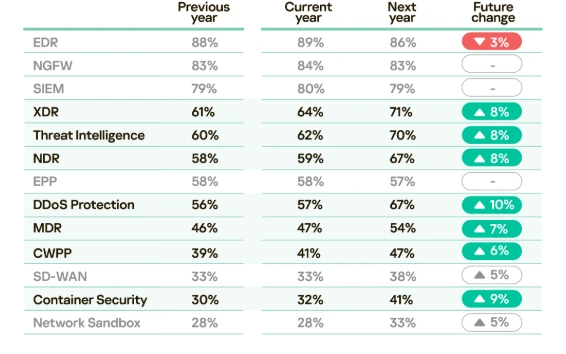
Demand for complementary tools is growing too. Threat Intelligence and Network Detection and Response (NDR) adoption should each climb by eight points, while DDoS protection could jump 10 points, from 57% to 67%. Container security and Managed Detection and Response (MDR) also show strong gains, rising nine and seven points respectively.
Together, these trends point to a shift towards integrated cybersecurity ecosystems. In this model, central platforms correlate data from many sources, while specialised tools add deeper protection where companies need it.
Why Integrated Cybersecurity Matters for Response Times
Ilya Markelov, Head of Unified Platform Product Line at Kaspersky, said the findings reflect a recognition that “traditional, siloed approaches are no longer sufficient in today’s complex threat landscape.”
“By unifying and automating their security tools, companies significantly enhance visibility, reduce response times and improve coordination,” he said. He also described the shift as “vital for establishing robust protection” in an environment where immediate action is essential.
Steps Towards an Integrated Cybersecurity Approach
For organisations planning their next move, Kaspersky recommends the following:
- Consolidate monitoring and response on one platform. Kaspersky Next XDR Expert, for example, aggregates and correlates data from multiple sources and uses AI to speed up detection and automated response.
- Centralise security analytics. Teams running a security operations centre can use Kaspersky SIEM to correlate events and turn large volumes of telemetry into actionable insights.
- Add dedicated threat intelligence. Kaspersky Threat Intelligence gives teams insight into threat actors, their tactics, techniques and procedures (TTPs), and indicators of compromise (IoCs).
- Protect cloud-native and virtual environments. Kaspersky Cloud Workload Security covers hybrid cloud and DevOps infrastructure.
- Extend in-house teams with managed services. Kaspersky Managed Detection and Response offers expert-led threat monitoring, investigation and response, easing the burden on internal staff.
Organisations can also review their strategy with Kaspersky’s interactive IT Security Calculator, or identify weak spots through the questionnaire-based Cyber Risk Heatmap.
Founded in 1997, Kaspersky is a global cybersecurity and digital privacy company. The company says it has protected more than a billion devices and works with nearly 200,000 organisations. More information is available at kaspersky.com.